Mrs Coppins
The Pale HorseMrs Coppins is the landlady who watched Mrs Davis fall gravely ill, received Father Gorman at the sick woman’s bedside, and later gave Inspector Lejeune an account that helped define the mystery around her tenant. She is an energetic, practical witness: attentive to illness and household details, outspoken about poor public services, and unsure how much significance to attach to the clues she remembers.
Identity and First Appearance
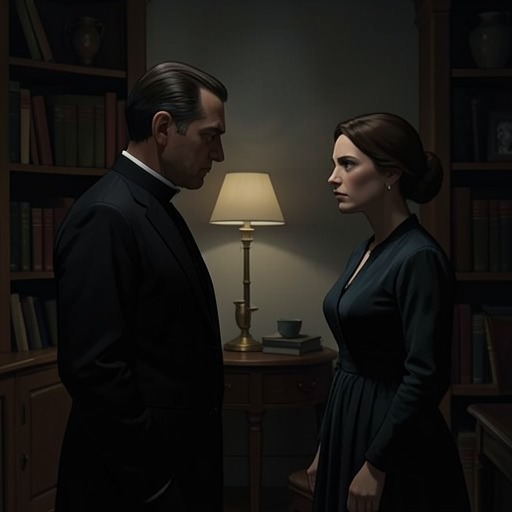
Mrs Coppins appears at the door of No. 23 when Father Gorman arrives to visit the dying Mrs Davis. Described as large and red-faced, she welcomes him with enthusiasm and immediately explains that her lodger is in a bad way. As she leads him up the narrow stairs, her attention moves from Mrs Davis’s condition to the difficulty of obtaining medical help. She says she has telephoned for assistance and complains that her own sister’s husband once waited six hours after breaking his leg. The anecdote gives her a forceful, everyday voice: she measures the emergency against a familiar grievance about the Health Service, even as she hurries the priest towards the sickroom.
Her manner combines concern with plain-speaking. She believes Mrs Davis should be in hospital, but the account does not present her as having control over the tenant’s choices: Mrs Davis has resisted seeing a doctor, and Mrs Coppins can only describe what she has observed and try to get help. The scene establishes her as a witness close to the events, whose knowledge comes from sharing a house with the woman rather than from knowing her past.
Mrs Davis’s Illness
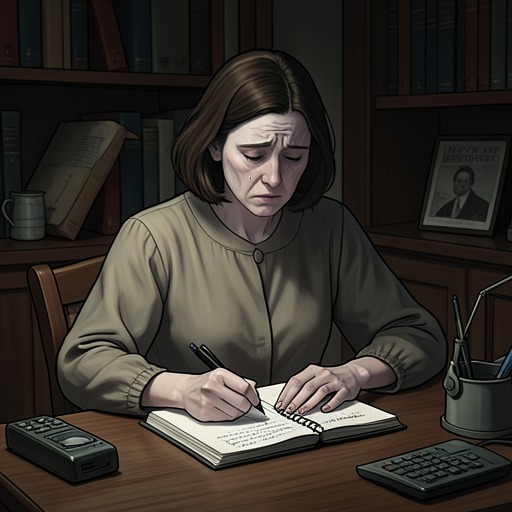
Mrs Coppins traces the illness from what she understood to be influenza. Mrs Davis had seemed to improve, but, in her landlady’s view, went out again too soon. She returned one night looking desperately ill, took to her bed, and would not eat. When Mrs Coppins saw that she had a raging fever and that the illness had gone to her lungs, she thought medical attention was necessary; Mrs Davis did not want a doctor. Mrs Coppins’s brief confirmation that the condition was pneumonia gives the priest a clear account of the immediate crisis, though not a medical diagnosis of her own.
Her later recollection adds a more precise sequence. Mrs Davis recovered, or nearly recovered, and went back to work despite Mrs Coppins advising her to wait another day or two. On the second evening after returning, she came home with a high fever and could scarcely climb the stairs. Mrs Coppins urged her again to have a doctor. She describes the worsening signs across the day: Mrs Davis’s eyes became glassy, her cheeks burned, and her breathing grew terrible. The account makes the return to work a consequential turning point in the illness as Mrs Coppins experienced it, while leaving the precise cause of the fatal condition unresolved.
The Priest and the Tenant’s Hidden Past
As Mrs Davis’s condition deteriorates, her request changes the immediate course of events. She can hardly get the words out, but asks for a priest quickly, saying that otherwise it will be too late. Mrs Coppins understands that the request is not for the local vicar: Mrs Davis insists on a Roman Catholic priest. The distinction surprises her because, during the time she has known the tenant, she has seen no crucifix and had not known her to be Roman Catholic. Father Gorman’s arrival therefore depends on a fact about Mrs Davis that her landlady had not previously recognized.
When Inspector Lejeune questions her after Mrs Davis’s death, Mrs Coppins says the tenant had rented from her for about six months, paid regularly, and seemed quiet, respectable, and pleasant. She cannot identify where Mrs Davis came from or supply a fuller account of her life. The limits of her knowledge sharpen the contrast between the ordinary reliability of the tenancy and the uncertainty surrounding the tenant’s identity: a steady rent payment and an agreeable manner had not made Mrs Davis’s history visible to the person sharing her home.
The one possession that had made Mrs Coppins wonder was a suitcase. It was good-quality but not new, and its painted-over initials appeared to read I.D., matching the name Jessie Davis; underneath, she thought the original letter might have been H or A. She had assumed that someone might buy a second-hand case and alter its initials, so she had not treated the detail as suspicious at the time. Her recollection gains weight beside Inspector Lejeune’s observation that the dead woman had few personal possessions: she kept no letters or photographs, and had no apparent insurance card, bank book, or cheque book. Mrs Coppins’s testimony does not solve the question of identity, but it helps establish how little ordinary documentary trace Mrs Davis left behind.
Narrative Role
Mrs Coppins links the private circumstances of Mrs Davis’s final illness to the investigation that follows. Her account supplies the chronology of the fever, the repeated refusal of a doctor, the request for a Roman Catholic priest, and the unusual suitcase initials. These details arrive through a landlady’s domestic recollections rather than through a formal explanation of Mrs Davis’s past. Their significance lies partly in the gap between what Mrs Coppins could observe and what she could know: the tenant’s habits seemed unremarkable, yet her altered initials, sparse belongings, and undisclosed religious affiliation leave questions that ordinary household familiarity cannot answer.